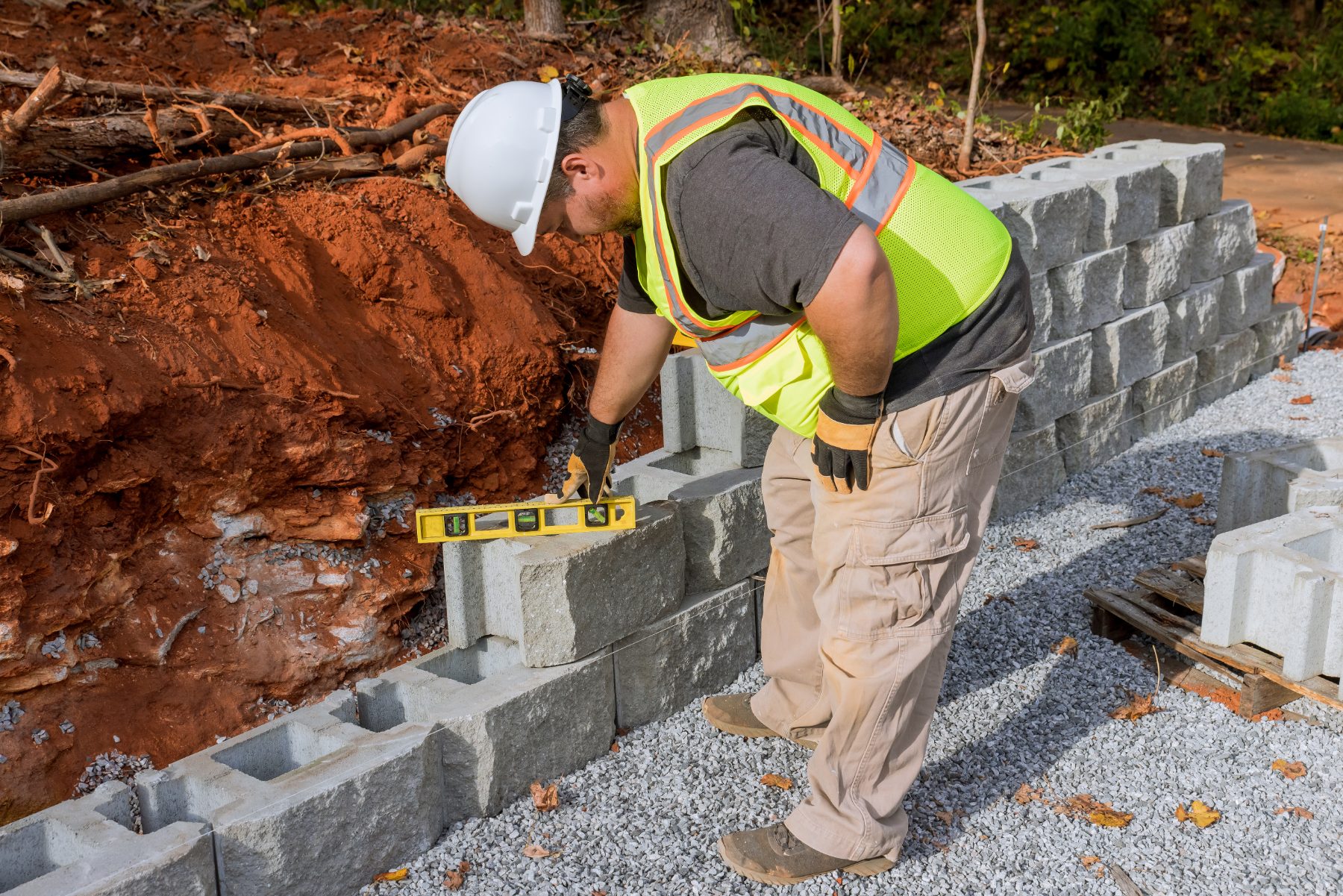
A retaining wall is the cost people most often leave out of a build, a subdivision or a backyard project until the site plan arrives and there is a level change on it. It is priced by the lineal metre, but the metre rate moves a long way with height, material, soil, drainage and how easily a machine can get to the spot. This guide sets out the published per-metre ranges from two current Australian sources, what sits on top of the wall price that people forget, what moves the figure, and how people usually fund one when it is part of a bigger job.
It is a cost guide. If you are working out how to pay for it, the funding routes are covered in renovation loans, and the wider projects a retaining wall usually belongs to are in house extension cost, cost to subdivide land and cost to build a house.
Why there is no single retaining wall price
Two things make retaining walls harder to price than a deck or a fence. The first is physics: the soil behind a wall pushes on it, and that pressure rises with depth, so a 2-metre wall is not twice the job of a 1-metre wall. RetWall’s engineer puts it bluntly: doubling the height roughly triples the construction cost. The second is that the wall you see is only part of what you pay for. Footings, drainage, engineering, a permit and sometimes a soil report all sit behind the facing, and none of them is included in a materials price at the landscape yard.
So a per-metre figure is only meaningful with a height and a material attached to it, and even then it is a range.
Retaining wall cost per metre, by material and height
The table below is drawn from RetWall’s published guide (Chris Suciu, CPEng, reviewed June 2026), which gives typical installed cost per lineal metre including labour, materials, excavation and basic drainage, at four heights. RetWall notes these are construction costs only and describes them as 2025 figures.
| Wall type | 1.0 m high | 1.5 m high | 2.0 m high | 3.0 m high |
|---|---|---|---|---|
| Concrete sleeper and post | $300–$500 | $450–$700 | $600–$1,000 | $900–$1,500 |
| Treated timber sleeper | $200–$400 | $350–$600 | $500–$800 | Not recommended |
| Block masonry (Besser) | $400–$700 | $600–$1,000 | $800–$1,400 | $1,200–$2,000 |
| Gabion | $400–$700 | $600–$1,000 | $800–$1,300 | $1,000–$1,800 |
Per lineal metre, installed, excluding engineering, permit and soil report. Source: RetWall, reviewed June 2026.
What’s The Damage, an independent cost-guide site that states it verified its retaining wall prices in September 2026, publishes national per-metre ranges at around 1 metre high that broadly agree with the lower end of RetWall’s table and add a few materials RetWall does not price:
| Material (approx. 1 m high, per lineal metre) | Low | Typical | High |
|---|---|---|---|
| Timber sleeper | $200 | $320 | $450 |
| Concrete sleeper | $250 | $400 | $600 |
| Block / Besser | $300 | $500 | $750 |
| Sandstone | $350 | $550 | $700 |
| Boulder / rock | $250 | $400 | $600 |
| Gabion | $300 | $500 | $800 |
Source: What’s The Damage, prices verified September 2026.
The two sources do not agree exactly, and that is the point. RetWall, written by a practising retaining-wall engineer, prices gabion and block work higher and concrete sleepers a little higher at 1 metre than What’s The Damage does. Both describe their figures as guides. Treat the overlap between them as the realistic band for a straightforward site, and expect a difficult site to sit above it.
What sits on top of the wall price
Both sources are consistent that the wall itself is not the whole bill. RetWall’s breakdown of a typical project has four components:
- Engineering design: $600 to $1,500 or more. Structural drawings, calculations and a certificate of compliance. Required by most councils above a height threshold that varies by state, commonly somewhere between 600 mm and 1 metre.
- Building permit: $500 to $1,500. Document review, inspections and the final certificate, whether through council or a private certifier.
- Soil report: $300 to $800. Not always required. RetWall’s view is that a report can pay for itself by letting the engineer use less conservative, and therefore cheaper, design assumptions.
- Construction: the per-metre figures above.
What’s The Damage adds two line items people forget: drainage behind the wall at roughly $30 to $80 per lineal metre if it is quoted separately, and demolition and removal of an old failed wall at $50 to $180 per lineal metre before the new one goes in. Both sources describe drainage failure as the leading cause of retaining wall failure, so it is not the place to save money.
Worked illustration: a 10-metre wall at 1 metre
What’s The Damage puts a standard 10 lineal metre wall at 1 metre high at $2,500 to $7,000 installed. Using RetWall’s concrete sleeper range for the same wall gives $3,000 to $5,000 for construction, then engineering, a permit and possibly a soil report on top, which could add anywhere from about $1,100 to $3,800 depending on what the council requires. That is how a “$400 a metre” wall becomes an $8,000 project, and it is the reason to price the whole job rather than the facing.
What moves the price most
Both sources list the same drivers. In rough order of how much they can move the figure:
- Height. The single biggest factor. Pressure rises with depth, so footings go deeper, sections get thicker and drainage gets more serious. Above roughly 1 to 1.5 metres most councils require engineering and approval, which adds cost of its own.
- Material. Timber sleepers are cheapest to install and shortest-lived; What’s The Damage gives treated pine 15 to 20 years against 50-plus for concrete sleepers and block. Sandstone and engineered block sit at the top of the range.
- Length. Set-up costs such as mobilisation, equipment and a concrete pump are spread across the metres, so a short wall costs more per metre than a long one.
- Excavation and access. If an excavator, a concrete truck and a boring rig can reach the wall, it is efficient. A rear yard, a steep block or a narrow side passage means hand digging and hand carrying, which RetWall says can double or triple construction cost.
- Drainage. Agricultural pipe, gravel backfill and weepholes are essential, and the wetter the site the more of it there is.
- Engineering and surcharge. A wall holding up a driveway, a pool or a building carries extra load and needs a heavier design, which costs more to design and to build.
- Soil and site conditions. Reactive clay needs deeper footings and more drainage; rock needs breaking; sandy or waterlogged ground may need dewatering. A soil report is how you find out before the quote, not after.
- Location. What’s The Damage’s city figures start at around $180 a metre in Hobart and around $230 in Sydney and Darwin for the simplest walls, and regional sites can carry delivery and mobilisation premiums that metropolitan ones do not.
How people fund a retaining wall
On its own, a small garden wall is usually paid for from savings. The reason retaining walls turn up in finance conversations is that they are rarely on their own: they arrive with a subdivision, a sloping-block build, a house extension, a pool or a granny flat, and at that scale the wall is one line in a larger budget. How that larger budget is funded depends on whether the work is cosmetic or structural, and on what equity is available, and the routes are set out in renovation loans. Little Home Loans does not offer a retaining-wall loan as a product; what we can do is help you work out which funding route suits the whole project the wall is part of.
If the wall is part of building on a block, the approvals side is covered in owner-builder approvals and the lending side in land and construction loans.
Getting a quote you can compare
- Get the engineering done first where the height requires it. With drawings in hand, every builder quotes the same wall, and RetWall’s view is that an engineer will often suggest a cheaper wall type than the one you were quoted.
- Ask for the quote broken into excavation, footings, wall, drainage, backfill and rubbish removal, so you can see what is and is not included.
- Confirm who is arranging the permit and whether the fee is in the price.
- Check the height threshold with your council before you assume no approval is needed.
- Ask about the boundary. A wall on or near a boundary raises questions about who pays and who owns it; check with council and the neighbour before you build.
Frequently asked questions
How much does a retaining wall cost per metre in Australia?
Published 2026 guides put a straightforward 1-metre-high wall at roughly $200 to $450 per lineal metre for timber sleepers, $250 to $600 for concrete sleepers and $300 to $750 for block, installed. Taller walls cost far more per metre, and engineering, permits and soil reports are extra. These are guide ranges from RetWall and What’s The Damage, not quotes.
How much does a 10-metre retaining wall cost?
What’s The Damage puts a 10-metre wall at 1 metre high at $2,500 to $7,000 installed. Add engineering of $600 to $1,500, a permit of $500 to $1,500 and possibly a soil report of $300 to $800 where the council requires them, and a modest wall can become an $8,000 to $11,000 project.
Why does a taller retaining wall cost so much more?
Because the soil pressure on a wall increases with depth. A taller wall needs deeper footings or piers, thicker sections, more reinforcement and more drainage. RetWall’s engineer estimates that doubling the height roughly triples the construction cost, and taller walls also cross the thresholds where engineering and council approval become mandatory.
Do I need council approval or an engineer for a retaining wall?
Usually above a height threshold that varies by state and council, commonly somewhere between 600 mm and 1 metre, and almost always above 1.5 metres or where the wall supports a driveway, pool or building. Check with your council before you assume a wall is exempt; the permit and engineering costs are part of the budget.
What is the cheapest type of retaining wall?
Treated timber sleepers are the cheapest to install in both sources we read, at roughly $200 to $450 per metre for a low wall. They are also the shortest-lived, with What’s The Damage citing 15 to 20 years against 50 or more for concrete sleepers and block, so the cheapest wall to build is not always the cheapest to own.
Can I get a loan for a retaining wall?
Not as a specific product from Little Home Loans. Retaining walls are usually funded as part of a larger project, such as a subdivision, extension, pool or build, through whichever funding route suits that project, which might be a renovation loan, equity release, a construction loan or a personal loan. Our renovation loans guide sets out how those routes differ.
Does the price include drainage?
Not always. Some quotes bundle agricultural pipe and gravel backfill into the per-metre rate; others itemise drainage at roughly $30 to $80 per lineal metre. Ask, because drainage failure is the most common reason retaining walls fail, and a quote that leaves it out is not a cheaper wall, it is an incomplete one.
Working out how to fund the whole project?
If the retaining wall is one line in a bigger build, extension or subdivision budget, talk to us about how the whole thing could be funded before you commit to the quote.
Start an enquiry, call 1300 391 390 or contact us.
Written and reviewed by the Finance Director at Little Home Loans.
This article is general information only. Cost figures are published guide ranges from the sources named, read on 21 September 2026; they are not quotes and your project may fall outside them. It does not take your objectives, financial situation or needs into account; consider whether any finance product is appropriate for your circumstances. Little Home Loans operates under Australian Credit Licence 506065 (Five Tees Pty Ltd). Lending is subject to approval, lending criteria, terms, conditions and fees.