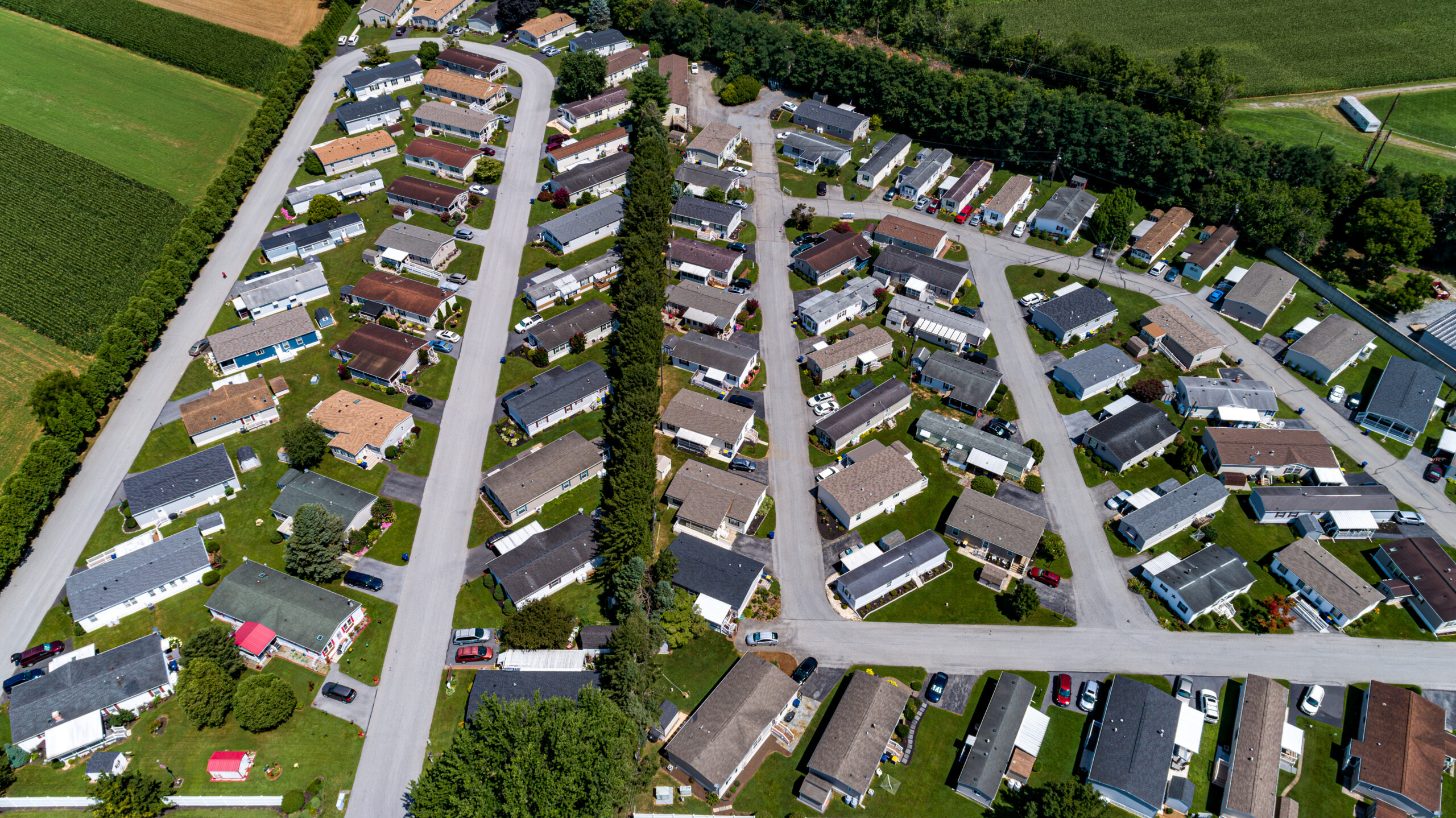
A land lease community is a residential community where you buy the home but not the land it sits on. In many land-lease or residential-park arrangements, the buyer owns the dwelling but does not own the underlying land; instead, they occupy the site under a lease or site agreement with the community operator. The exact legal structure, fees and financing implications vary by state, operator and community — which is why the question “how does a land lease community work?” has a general answer and a lot of local detail.
This guide gives the general answer, uses Queensland’s manufactured-home framework as a clearly labelled example of how one state regulates these communities, and explains how the finance side tends to differ from a conventional house purchase. It is an information page: Little Home Loans does not offer a land-lease loan product, and nothing here is a promise that any particular finance will be available for a particular home.
What you are buying — and what you are not
In a conventional house purchase you buy the land and the house on it together, and you hold title to both. In a land lease community the two are separated:
- The dwelling — typically a manufactured, relocatable or modular home — is purchased and, in most arrangements, owned by you.
- The land stays with the community operator. You occupy your site under a lease, licence or site agreement and pay a recurring site fee or site rent for it.
- Common facilities — clubhouses, pools, gardens, roads — are usually operator-owned and shared, with their upkeep funded through the site fees.
Because you generally do not hold freehold title to land, a land lease community is different from a strata unit, a retirement village under retirement-village legislation, and a caravan park stay — even though it can look like any of them from the outside. Which legal framework applies depends on the state and on how the community is set up, and that framework is what determines your rights, the operator’s obligations and what happens when you sell.
Who land lease communities tend to suit
Purpose-built land lease communities are commonly marketed to over-50s and downsizers, and the appeal is straightforward: a newer, low-maintenance home at a lower purchase price than the equivalent house-and-land, in a community with shared facilities, without the responsibility of owning and maintaining the land. Some residents fund the purchase from the sale of a larger family home; others are moving from renting. The trade-off is the ongoing site fee, the operator’s rules, and the fact that what you own is a dwelling on land you lease rather than a freehold property.
How the ongoing costs typically work
The cost structure is set by the site agreement and by the state framework that governs it. In general terms, the recurring cost is the site fee or site rent, and how that fee can change over time is one of the most important terms in the agreement. Beyond that, what is charged and how is a matter for each operator’s disclosure documents. Do not assume a fee exists or does not exist — read the documents for the specific community.
Queensland example (labelled)
The following describes Queensland only. Other states regulate these communities differently, and a Queensland rule should not be read as an Australia-wide statement.
In Queensland, homes in residential parks are covered by the Manufactured Homes (Residential Parks) Act 2003. The Queensland Government describes a manufactured home as a structure that has the character of a dwelling house, is designed to be moved from one position to another, and is not permanently attached to land (a converted caravan is generally not treated as a manufactured home, with limited exceptions). Residential parks may be mixed-use or purpose-built; purpose-built parks are made up of manufactured homes under site agreements and are often targeted at the over-50s.
The home owner rents the site under a site agreement with the park owner. According to the Queensland Government’s guidance, the site agreement allows you to rent a particular site in the park where your home is positioned and gives you shared use of the park’s common areas and facilities. It must set out, among other things:
- details of the site rent — how often it is paid, how it is paid, how many people it covers, and how and when it may increase (including by order of the Queensland Civil and Administrative Tribunal);
- costs and billing arrangements for utilities and services such as electricity, gas, water, sewerage and other services specific to the park;
- the maximum number of people who may live in the home, whether pets are allowed, the park rules, and any special terms.
Queensland guidance also notes that certain special terms are prohibited in site agreements under the Manufactured Homes (Residential Parks) Regulation 2017, that pre-contractual disclosure documents and a sale agreement are part of the purchase, and — in its own words — that it is very important to seek independent legal and financial advice to check the site agreement and any purchase agreement before you sign. Free information is available in Queensland through the Queensland Retirement Village and Park Advice Service.
That is one state’s framework. If you are looking at a community elsewhere, start with that state’s fair trading or housing authority and the operator’s disclosure documents.
How a home in a land lease community may be financed
This is where land lease communities differ most from a standard purchase, and the honest answer is conditional. Because the buyer may not hold conventional freehold title to the land, standard residential mortgage structures may not always apply. Available finance depends on the legal interest being purchased, the dwelling itself, the security available, the borrower’s circumstances and lender policy.
In practice, that means the finance conversation starts with questions rather than a product:
- What exactly is being purchased? A dwelling only, a dwelling plus an interest in a site agreement, or something else. The contract and disclosure documents answer this.
- Is the dwelling treated as fixed to the land or as a movable structure? A manufactured or relocatable home that is designed to be moved is assessed differently from a house on its own title.
- What security is available? Without land title, a lender may look to the dwelling, to other property the buyer owns, or to the buyer’s broader financial position.
- What are the buyer’s circumstances? Many buyers in these communities are downsizing with sale proceeds and need little or no finance; others need to bridge a gap or fund the whole purchase.
- What is the lender’s policy? Lenders differ on whether, and on what terms, they will finance a home in a land lease community, and policy can change.
We have written elsewhere about how movable dwellings are approached by lenders — see financing a relocatable or transportable home and our relocatable and transportable home finance page — and the same starting point applies here: identify what you are buying, then find out which options fit it. Little Home Loans is an information platform; if you would like to talk through a specific community and dwelling, contact us and we will refer the enquiry to our finance partner, who can look at the documents and tell you what is and is not possible for that purchase.
Questions to answer before you commit
- Which legal framework covers this community in this state, and what does it give you and require of the operator?
- What is the site fee now, and exactly how can it change? Fixed increases, indexed increases, reviews — the mechanism matters more than today’s number.
- What other charges exist for this community? Read the disclosure documents for the specific community rather than assuming a standard set. Ask directly about anything payable on sale or exit.
- What happens when you sell? Who can buy, whether the operator is involved in the sale, and whether any amount is payable to the operator on sale. This varies by community and by state.
- What happens if the operator sells or the park closes? State frameworks differ on the protections available.
- Can the home be financed, and on what basis? Ask before you sign, not after — and ask about the specific dwelling and community, not land lease communities in general.
- Have you had independent legal and financial advice? Every state authority we have read says the same thing about this step, and for a purchase that is neither a house nor a tenancy it is the step most worth paying for.
How this compares with other housing options
A land lease community sits between several other options this site covers. A granny flat keeps the home on land you (or family) already own. A tiny home or house on wheels is movable but usually sits on private land or a rented site rather than in a purpose-built community. A modular home is generally installed on land you own and financed accordingly. Retirement villages are governed by separate legislation in each state and typically involve a different financial structure again. The right comparison depends on whether owning land matters to you, how much you want to spend upfront, and what ongoing costs you are comfortable with.
Land lease community FAQs
What is a land lease community?
A residential community where you buy the home but lease the land it sits on from the community operator, usually under a site agreement with an ongoing site fee. The legal structure, fees and rights vary by state, operator and community.
Do you own the home in a land lease community?
In most arrangements, yes — you own the dwelling and lease the site. What you do not usually hold is freehold title to the land. Check the contract and disclosure documents for the specific community, because the interest being purchased can differ.
Can you get a mortgage on a home in a land lease community?
Not always in the conventional sense, because there may be no land title to secure it against. Available finance depends on the legal interest being purchased, the dwelling, the security available, the borrower’s circumstances and lender policy. Ask about the specific home and community before committing.
What is a site agreement?
The agreement under which you occupy your site. In Queensland, for example, it is a regulated agreement to rent a particular site in a residential park that also gives shared use of common facilities and must set out the site rent, how it may change, utilities billing and park rules. Other states use different frameworks.
Is a land lease community the same as a retirement village?
No. Retirement villages are governed by separate retirement-village legislation in each state and commonly involve a different financial structure. Some land lease communities are marketed to a similar age group, but the legal and financial arrangements differ. Check which framework applies.
What ongoing fees do land lease communities charge?
The recurring cost is generally the site fee or site rent, and utilities are usually billed as set out in the agreement. Whether any other charges apply — including on sale or exit — depends on the community and the state framework. Read the operator’s disclosure documents rather than assuming a standard set of fees.
Where can I get advice before buying?
From an independent solicitor and financial adviser, and from your state’s housing or fair trading authority. Queensland, for example, offers free information through the Queensland Retirement Village and Park Advice Service and publishes guidance on site agreements and buying a manufactured home.
Talk to us about your options · 1300 391 390 · Check your finance options
Written and reviewed by the team at Little Home Loans
This article is general information only and does not take into account your objectives, financial situation or needs. It is not legal advice. The legal structure of land lease and residential-park communities, the fees charged and the finance available vary by state, operator, community and dwelling; the Queensland material above describes Queensland only and was read from Queensland Government guidance on 16 September 2026. Little Home Loans is an information platform and does not offer a land-lease loan product; finance enquiries are referred to our finance partner, which operates under Australian Credit Licence 506065 (Five Tees Pty Ltd). Lending is subject to approval, lending criteria, terms, conditions and fees, and availability of any particular option is not guaranteed. Obtain independent legal and financial advice before signing a site agreement or purchase contract.