Quick answer: Quick answer: There is no reliable national average for modular home costs in Australia, and no credible dollars-per-square-metre figure — builders advertise very different scopes under the same words. In 2026, advertised starting prices from named builders run from about $153,000 for a “simple starter home” in South Australia to $300,000+ for a “smaller modular home” in Victoria. Those two figures are not comparable: one includes delivery to site and the other does not confirm it, neither states GST treatment, and neither includes site works. Sources, dates and the full inclusion detail are set out below.
What “modular home cost” actually includes
The headline price you see advertised is usually the base module — the transportable building itself. A realistic budget also needs:
- Delivery and craning — distance from the factory and site access matter a lot.
- Site works — clearing, earthworks, foundations/piers, retaining.
- Connections — power, water, sewer or septic, stormwater, NBN.
- Council and approvals — permits, planning, certifications.
- Finishes and extras — decks, driveways, landscaping, appliances, upgrades.
Always ask a supplier whether a quote is base or turnkey (ready to live in) — the gap between the two is where most budget surprises happen.
Examples of advertised modular-home prices in 2026
The figures below are individual builders’ own advertised prices, recorded with what each one does and does not include. They are examples, not a market average, and — as the next section shows — they are not directly comparable with each other.
| Builder | Service area | Size / configuration | Advertised price | GST stated? | Delivery included? | Site works / installation included? |
|---|---|---|---|---|---|---|
| Anchor Homes | All Victoria; southern & central NSW; ACT (factory: Stratford, VIC) | “Smaller modular home” — size not specified by builder | $300,000+ | No | Yes — delivery to site built into base price | No |
| Anchor Homes | As above | “Family-sized home” | $500,000+ | No | Yes | No |
| Anchor Homes | As above | Large custom, architecturally designed | $700,000 – $1,000,000+ | No | Yes | No |
| Modify (formerly Outback Building Group) | South Australia (factory: Murray Bridge) | “Simple starter home” | from ~$153,000 | No | Not confirmed — builder notes only that “some builders include transport and installation within a set radius” | No — standard footing system included, broader site works are not |
| Modify | As above | Mid-range, upgraded finishes | from ~$229,000 | No | Not confirmed | No |
| Modify | As above | Large custom designs | $460,000+ | No | Not confirmed | No |
| Modify | As above | Compact modular granny flat | from ~$107,000 | No | Not confirmed | No |
Modify also publishes indicative prices by module count and floor area: one module of about 36m² at $95,000–$125,000; one module of about 48m² at $115,000–$135,000; two modules of about 96m² at $240,000–$280,000; and two modules of about 112m² at $265,000–$295,000.
Sources. Anchor Homes, “How Much Does a Prefab Modular Home Cost in Victoria in 2026?”, published 4 August 2026, at anchorhomes.com.au/blog/how-much-does-a-prefab-modular-home-cost-in-victoria-in-2026, accessed 27 August 2026. Modify, “Modular Home Cost in Australia: The Truth Behind the Price Tag (2026 Guide)”, at builtbymodify.com.au/blogs/modular-home-cost (no publication date shown on the page), accessed 27 August 2026. Prices are the builders’ own advertised figures at those dates, described by them as indicative, and are subject to change. We have not verified them by quotation.
Why those prices cannot be compared with each other
Look at the two “entry level” figures: about $153,000 from one builder and $300,000+ from the other. That is close to a two-fold difference, and almost none of it is a like-for-like price gap. It is a scope gap.
- Different states. One builds for Victoria and southern NSW, the other for South Australia. Transport distance alone changes the number.
- Different things in the box. One includes delivery to site in the base price and says so explicitly, noting that this is “where many quotes quietly differ”. The other does not confirm delivery, and observes that only some builders include transport and installation, and then only within a set radius.
- Different definitions of “home”. “Smaller modular home” and “simple starter home” are marketing categories, not floor areas. Neither builder attaches a square-metre figure to its entry price.
- Neither states GST treatment. On a $300,000 figure that is a material ambiguity, and it is the first thing to ask.
- Neither includes site works. Both publish those as additional, and they are the costs that vary most between blocks.
This is why we do not publish a national “average modular home price” or a dollars-per-square-metre figure. Averaging these numbers together would produce something that looks authoritative and means nothing, because the underlying quotes are measuring different things.
The site costs that sit on top of every base price
Both builders publish these as additional. Modify puts indicative figures against several of them (builtbymodify.com.au, accessed 27 August 2026):
- Crane hire — approximately $260 to $1,530 per hour, with four to ten hour minimums, plus travel. Remote or complex lifts can push the delivery-day total to roughly $23,000–$30,600.
- Utility connections (electricity, water, sewer, telco) — roughly $7,600 to $30,600 depending on location.
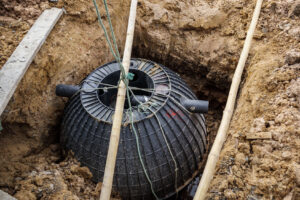
- Septic system where there is no sewer — commonly around $15,300 to $38,200.
- Sloping blocks — more than about 2m of fall can add up to roughly $30,600; very steep sites can increase total project cost by 30–50%.
Anchor Homes publishes the same categories without dollar figures, listing pre-construction fees (design and drafting, site engineering, energy assessment), council approvals, electrical, sewer, water and stormwater connections, structural engineering, re-establishment survey, site excavation or elevated footings, crane hire, and energy, bushfire (BAL) and wind rating upgrades as costs outside the base price.
Modify suggests holding a contingency of 10–15% on a well-planned build and 15–25% on a complex one. That is the builder’s own guidance, and it is a reasonable discipline to carry into a finance application.
Why official construction data does not answer this question
It is fair to ask why we cannot simply cite an official figure. The ABS publishes building approvals data including the value of approved dwellings, and the HIA reports on construction costs, and both are credible sources for the direction of the broader residential construction market. Neither isolates modular or prefabricated homes as a category, and neither separates a factory-built module from the site works, services and approvals that turn it into a finished home.
So official data tells you what is happening to construction costs generally. It does not tell you what your modular home will cost. Only an itemised quote on your block does that.
What your lender needs itemised before it will fund the build
This is where an unclear modular quote becomes a finance problem rather than just a budgeting one. Before assessing a construction or progress-payment facility, a lender generally wants to see the whole project costed, not just the module. Ask your builder to itemise, in writing:
- The base build, with a full inclusions schedule attached.
- Whether the price is inclusive or exclusive of GST.
- Transport to your address, with the distance or radius the price assumes.
- Crane and installation, including the assumed hours and what happens if access requires more.
- Footings and any excavation, retaining or elevated structure the block requires.
- Services — power, water, sewer or septic, stormwater, telecommunications.
- Council and planning approvals, and who lodges them.
- Any BAL, wind or energy-rating upgrades your site triggers.
- The payment schedule, and at what stage title to the module passes to you — this matters more for modular than for a traditional build, because much of the value sits in a factory rather than on your land.
- Your contingency, held separately from the base budget.
If you want to understand how lenders treat that structure, and which stages they will and will not fund, our guide to modular house financing walks through the process in detail.
Is a modular home cheaper than a traditional build?
Often, yes — for a few reasons. Building in a factory reduces weather delays and labour inefficiency, materials are bought at scale, and the fixed process makes pricing more predictable. The build is also usually faster, which can save on rent or interest during construction. That said, a premium modular home with high-end finishes can cost as much as a conventional build — “modular” describes how it’s built, not automatically cheaper.
Don’t forget the land and site costs
If you don’t already own land, that’s frequently the biggest line item and varies enormously by location. Sloping blocks, poor access or long service runs all add to site works. When you’re comparing modular quotes, make sure land, site works and connections are in your total — not just the module.
How modular homes are financed
Financing a modular or prefab home can work differently from a standard build, because part of the value sits in a structure built off-site before it’s fixed to your land. Not every mainstream lender is comfortable with that, which is where a specialist helps. At Little Home Loans we focus on alternative and non-standard housing, so we can talk you through modular and prefab home finance options and what lenders will want to see.
Modular home cost FAQs
How much does a modular home cost in Australia?
There is no reliable national average, and no credible dollars-per-square-metre figure, because builders price very different scopes. Advertised 2026 starting prices from named builders run from about $153,000 for a simple starter home in South Australia (Modify) to $300,000+ for a smaller modular home in Victoria (Anchor Homes) – but those two figures are not comparable: one includes delivery to site and the other does not confirm it, neither states GST treatment, and neither includes site works. The only figure that means anything for your project is an itemised quote on your own block.
Are modular homes cheaper than traditional homes?
Frequently, yes — factory construction reduces delays and waste, and pricing tends to be more predictable. The build is usually faster too, which can lower holding costs. However, a high-end modular home with premium finishes can match a conventional build, so “modular” doesn’t automatically mean cheaper.
What extra costs should I budget for?
Beyond the module itself: delivery and craning, site works (earthworks, foundations), service connections (power, water, sewer/septic, NBN), council permits and certifications, plus finishes like decks, driveways and landscaping. And land, if you don’t already own it. These extras are where base-price quotes catch people out.
Can I get finance for a modular home?
Often, yes, but not every lender treats modular builds the same as traditional ones, because part of the value is built off-site. A specialist in alternative housing finance can match you to lenders who understand modular and prefab construction. Speak to Little Home Loans about your plans and we’ll explain your options.
How long does a modular home take to build?
Because much of the work happens in a factory in parallel with site preparation, modular homes are often faster than traditional builds — commonly a few months from order to install, plus site works and connections. Timelines vary by supplier, design and council approvals, so confirm with your builder.
Planning a modular home? Get your numbers right, then let us help with the finance. Little Home Loans specialises in modular and prefab home finance.
Written and reviewed by the Finance Director at Little Home Loans.
This article is general information only and does not constitute credit or financial advice. Costs quoted are indicative estimates only and vary by design, site, location and supplier. Little Home Loans is powered by Alpha390 Finance, which operates under ACL 506065 (Five Tees Pty Ltd). Lending is subject to approval, lending criteria, terms, conditions and fees.